

Market Update - Q3 2025
Market Performance
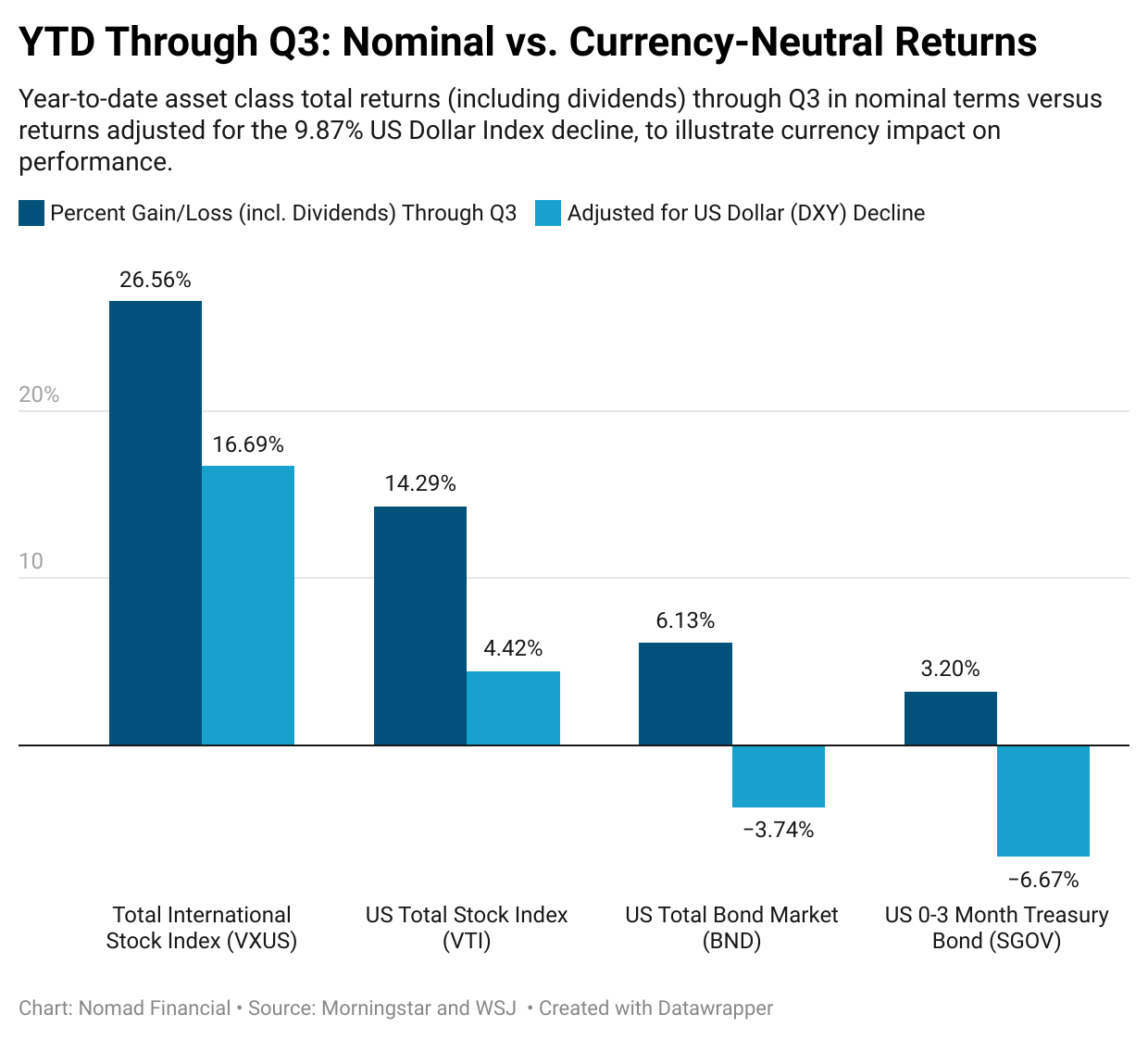
Strong market performance on the year continued through Q3. International stocks ended the quarter up over 26%, while U.S. stocks were up over 14%.1
The U.S. bond market index was up over 6%, while cash-equivalent ultra-short US Treasurys were up 3.2% at the end of the quarter.2
So far, it’s been another very good year for equity investors—especially those who had previously diversified into international stocks.
Currency Headwinds
While markets delivered strong returns through Q3, currency erosion has quietly diminished wealth for U.S. expats and aspiring expats holding dollar-denominated investments. Adjusting total returns for the Dollar Index decline—an albeit crude but useful proxy—reveals a stark reality for investors earning in dollars but spending in foreign currencies:
Cash/cash-equivalents in U.S. dollars go from a 3.2% gain to a 6.7% loss when adjusted for currency depreciation
U.S. bonds go from a 6.1% gain to a 3.7% loss
A “safe” fixed income portfolio of 75% bonds and 25% cash delivered a comfortably positive 5.4% return through Q3 in nominal dollar terms. But for a hypothetical American expat converting dollars to foreign currency to fund expenses, that same portfolio lost purchasing power. Subtracting the 9.9% Dollar Index decline from the 5.4% return reveals a loss of 4.5% in currency-adjusted terms. EU residents fared even worse, as the dollar declined more sharply against the euro than against the broader Dollar Index basket.
International stocks (VXUS) and U.S. stocks (VTI), however, provided a natural hedge against dollar weakness through Q3 of this year. International equity holdings benefit from direct exposure to foreign currencies through their underlying investments in non-U.S. companies. When the dollar weakens, the foreign currency-denominated returns from these holdings translate into more dollars upon conversion. Similarly, many U.S. companies generate significant revenue abroad—particularly technology giants, multinational manufacturers, and consumer brands with global reach. As foreign currencies strengthen relative to the dollar, these overseas sales become more valuable when converted back to dollars, boosting reported US earnings and stock valuations. This built-in currency diversification helps explain why equity portfolios held up better in purchasing power terms for expats compared to fixed income holdings, even before considering the markets’ strong nominal performance.
To illustrate the impact of the dollar’s depreciation: a static $1 million portfolio held from the beginning of the year effectively lost nearly $99,000 in purchasing power through Q3 when adjusted for the Dollar Index decline (approximately 9.9%)—an impact that doesn’t show up on quarterly investment statements. But for those living or planning to retire abroad, this quiet erosion translates into a very real reduction in spending power.
For retirees planning to remain in the US, currency fluctuations against foreign currencies are less relevant, though domestic inflation continues to erode purchasing power. Foreign goods are likely to become more expensive as the dollar weakens. Further, given our large ongoing federal deficits and loosening monetary policy, cash remains as precarious as ever.
That said, don’t abandon cash entirely. Every retiree should have enough on hand to weather a storm. The important takeaway is that each investor is different, and the risk of holding cash amounts that far exceed potential needs is real. Any cash reserves should be parked in safe vehicles at competitive yields: FDIC-insured savings accounts or CDs, or short-term Treasury bonds. Every situation is unique, so good advice is essential.
Our Investment Thesis
Given these currency dynamics and the broader economic environment, our investment thesis remains unchanged: stay invested in a low-cost, diversified portfolio with meaningful stock allocation despite ongoing volatility and concerningly high valuations.
The economic backdrop continues to be defined by persistent deficit spending—around 6% of GDP since 2022, levels historically seen only during crises such as World War II and COVID-19—combined with a Federal Reserve ready to support markets at the first signs of stress. This nearly $2 trillion annual deficit creates significant economic distortions while effectively functioning as a collective “surplus” for those positioned to benefit from government spending.
Though this path appears unsustainable long-term given currency debasement risks, it creates an environment where equities remain essential for preserving purchasing power. The Q3 currency erosion discussed above reinforces this reality.
Our Investment Philosophy
As we emphasized last quarter, staying invested in stocks, despite concerningly high valuations, is critical for long-term wealth preservation in an environment of fiscal excess and accommodative monetary policy—but for most clients equities should not be relied upon to meet short-term cash needs due to their volatility. Even with supportive macro factors, trend reversals can trigger years-long declines.
If you’ll need significant portfolio withdrawals over the next few years, it’s advisable to maintain adequate cash reserves to avoid forced selling during downturns. We continue to focus on disciplined rebalancing aligned with each client’s Investment Policy Statement rather than making dramatic changes in response to market events.
Remember that significant life changes—early retirement, health issues, or unexpected financial needs—usually warrant a reevaluation of your portfolio allocation. When your circumstances shift, let’s reassess your strategy to ensure it aligns with your current situation and goals.
Thanks for reading Nomad’s Substack! Subscribe for free to receive new posts.
© 2025 Nomad Financial
Privacy ∙ Terms ∙ Collection notice
For simplicity, we use VXUS as a proxy for international stocks, and VTI as a proxy for U.S. stocks
We use BND as a proxy for the U.S. total bond market and SGOV as a proxy for ultra-short cash-equivalent Treasurys.